The science · measurement
How NFR reads the nervous system.
Two instruments sit at the center of NFR. The first is frontal alpha asymmetry, the read you can’t fake. The second is heart-rhythm coherence, the ordered state the work happens in. Here is the published research that supports each, alongside what NFR’s own recordings measured.
The mechanism, in one line
Resonance breathing at about five breaths a minute pulls heart, breath, and brain into one rhythm. In that regulated, Alpha-Theta state the identity work happens, and an EEG measurement track reads, statement by statement, what the nervous system actually does.
NFR’s own data
Figures marked this way come from real NFR recordings, single sessions and our growing cohort, after artifact-gating. They are what our instrument measured.
The published research
Each statement is reported by the cited researchers and linked to the source. Named quotes from teachers in the field are their own words, attributed to the talk. They are voices, not peer-reviewed proof.
The instrument
Frontal alpha asymmetry — the read you can't fake
Ask someone whether a statement about who they are feels true and you get an edited answer, shaped by what they wish were so, what they think you want to hear, and what they can admit to themselves. The nervous system doesn’t edit. A fraction of a second before any of that, it has already leaned toward the statement or away from it, and that lean is what frontal alpha asymmetry reads. It is the instrument the whole platform is built on, so it is worth understanding exactly what it is.
There is nothing mystical in it. It comes down to three things stacked together: a brainwave that tells you when a region is working, two patches of cortex that pull in opposite directions, and a way of catching the instant the pull happens.
What it is
A needle between approach and withdrawal
Alpha is the brain’s idling rhythm, the 8-to-13-hertz wave a region gives off when it is online but not busy. It runs backwards from what you’d expect: alpha rises when a region powers down, and falls when that region springs into action. So alpha is an inverse meter. Less alpha over a patch of cortex means more work is happening there.
The front of the brain is split into two hemispheres that lean opposite ways. The left frontal cortex drives approach, the pull toward something: moving toward, wanting, reaching for. The right frontal cortex drives withdrawal, the pull away: holding back, guarding, turning aside. Richard Davidson spent decades establishing that approach/withdrawal split, and it has been refined and replicated ever since.
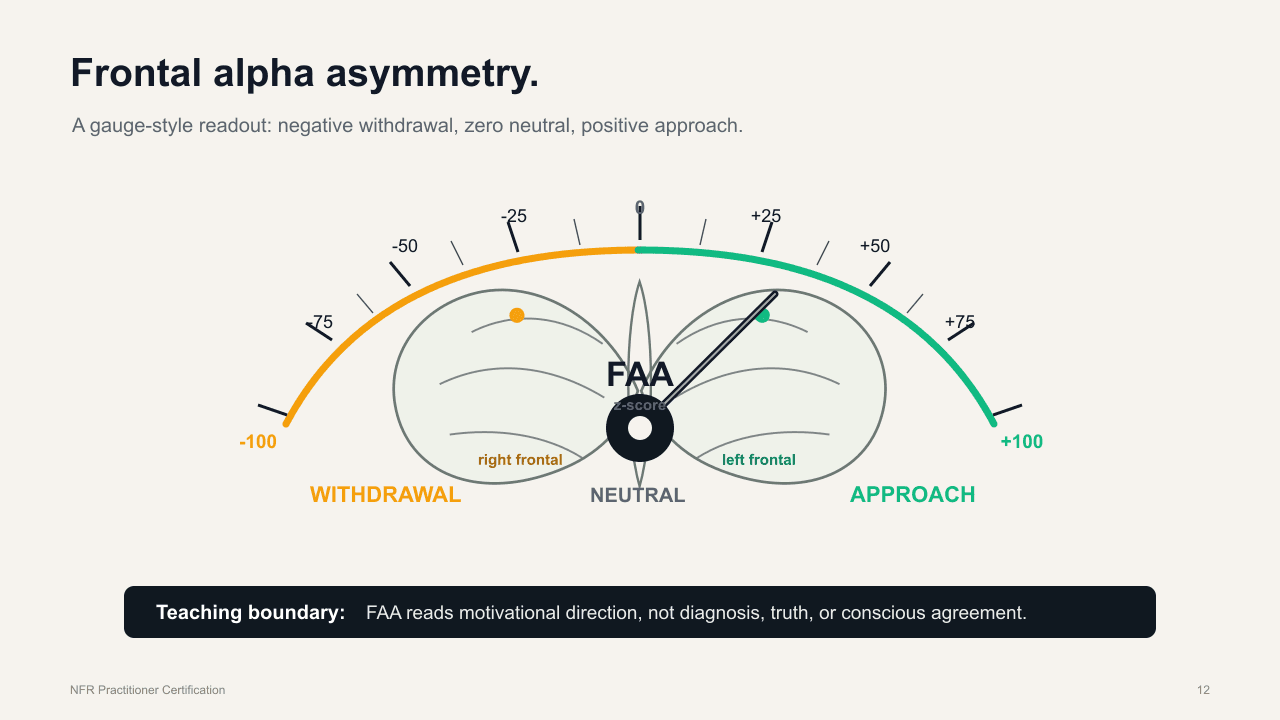
Frontal alpha asymmetry is simply which of those two is working harder, read through their alpha. More activity on the left than the right swings the needle toward approach; more on the right swings it toward withdrawal. It is one number, taken from the difference between the two sides, that captures the direction of the lean.
How the read works
Why you can't fake it
Here is why it matters that this is a brain signal and not a question. The lean appears before the conscious, narrating mind gets involved. Decision neuroscience has caught the brain committing to a choice seconds before a person reports deciding, and the same ordering holds here. By the time you could compose an answer, whether to agree, hedge, or perform, the asymmetry has already moved. You can edit what you tell a questionnaire. You cannot edit the needle, because it reads the response that happens first.
The whole thing turns on the moment we choose to read it. An older hope was that you could record a person at rest and call that their nature. The stronger evidence says a motivational tendency is not a constant hum in the background. It is a reaction, and a reaction only reveals itself when something calls it out. So NFR does not read a resting baseline. It reads event-locked: the brain’s response to one specific statement, captured in the window right after you hear it. The response, not the resting state, is the honest signal, and it is the well-replicated half of this science.
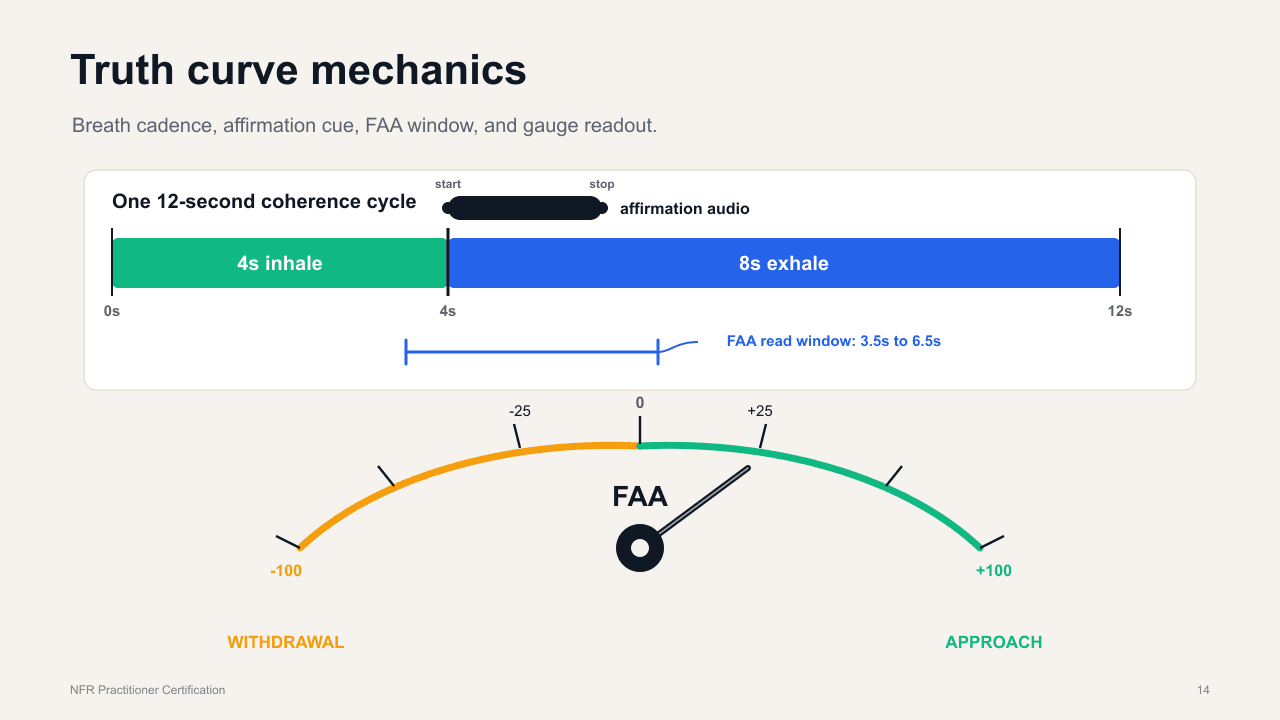
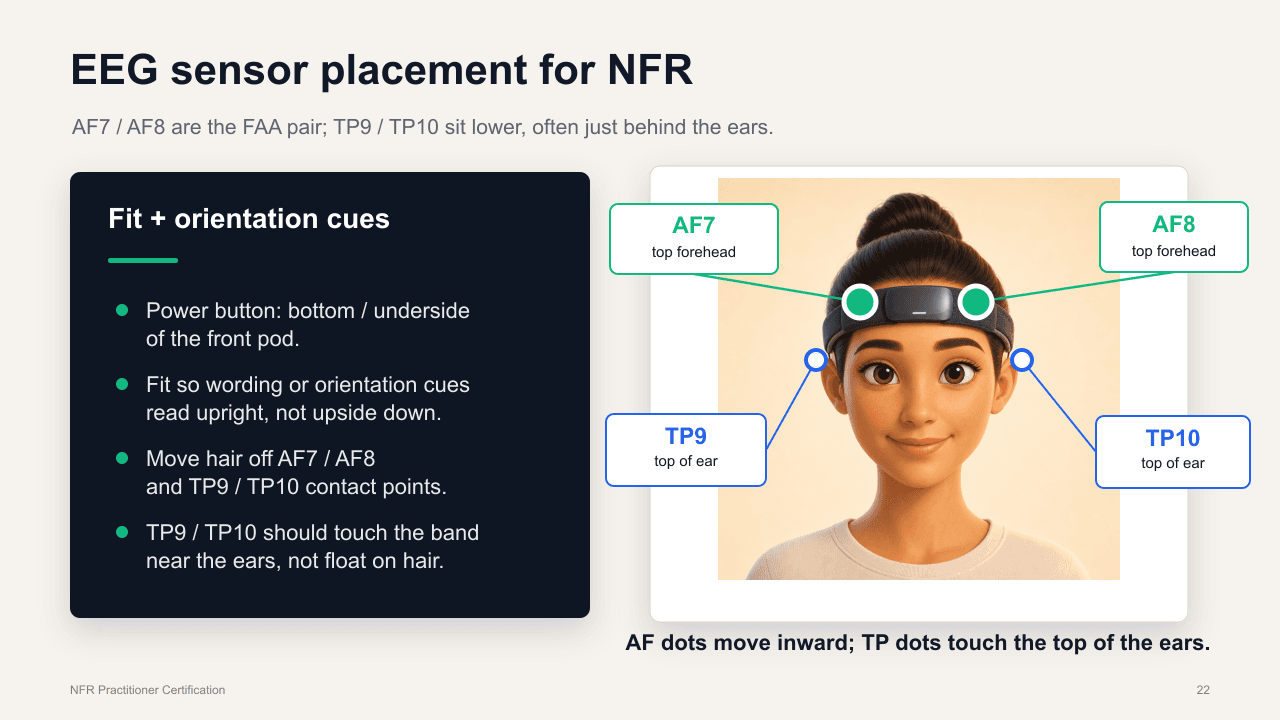
The read itself is disciplined. After each statement we take the difference between left and right alpha at the two sensors over the forehead, in a short window timed to the cue. Each statement is played five times and we average across the repetitions to pull the real response out of the noise, the same trial-averaging that event-related EEG has always relied on. The result is scored against your own session, so it is your scale and not a population’s, and each statement’s verdict is the median of its repetitions, robust to a single twitch or stray thought. The label stays honest about what it is: APPROACH, WITHDRAWAL, or NEUTRAL. Those are not labels for ‘true’ or ‘false’; they name which way the nervous system leaned. And every reading is artifact-gated before it counts.
How NFR uses it
The truth curve
Put that to work and you get the truth curve. You hear a sequence of present-tense statements about yourself: ‘I am safe,’ ‘I trust myself,’ ‘I am enough.’ The statement is deliberately neutral scaffolding. It names no particular story and carries no verdict of its own, so your nervous system is what supplies the lean. Twenty statements, five repetitions each, give a hundred event-locked reads in one session.
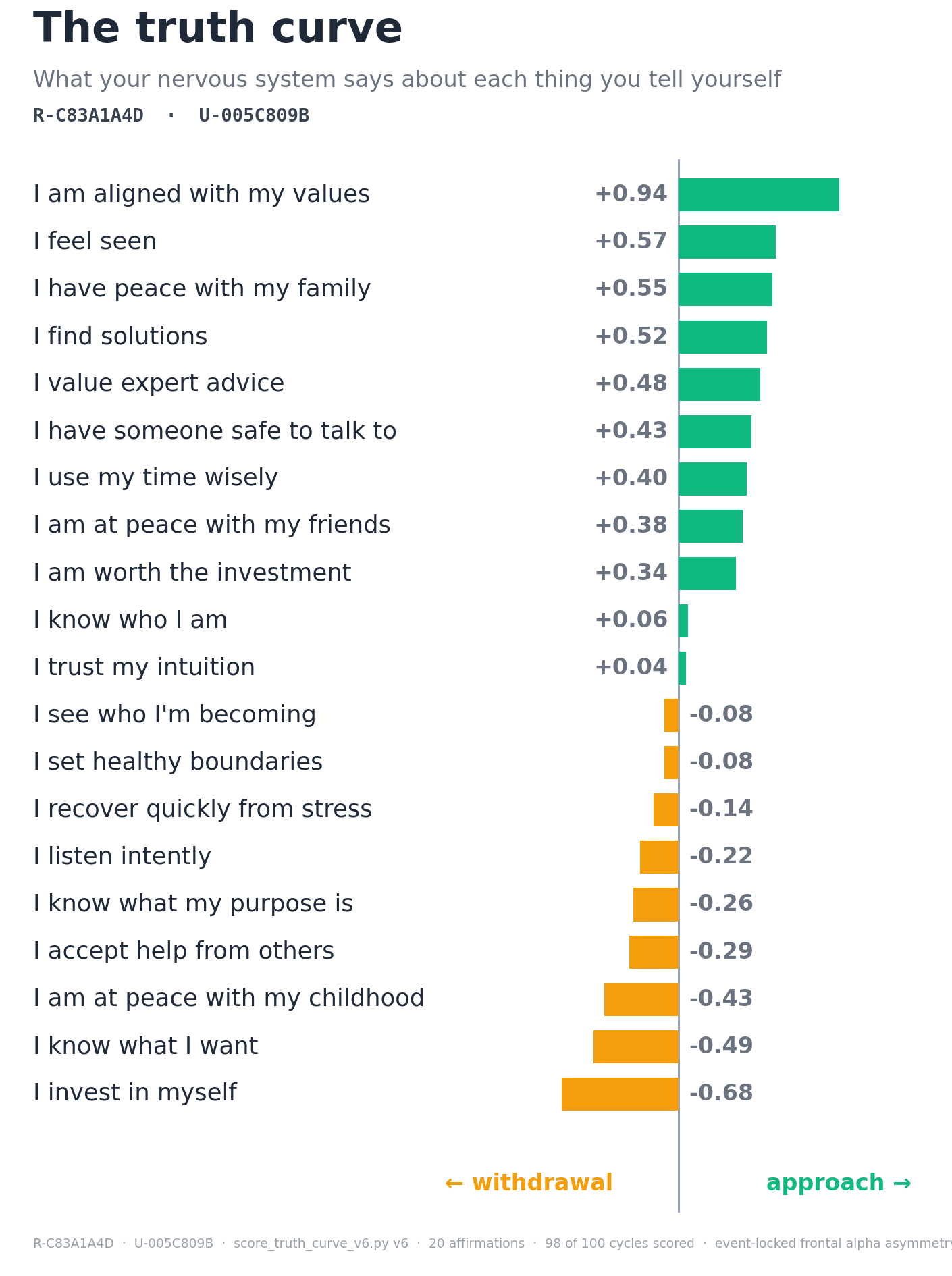
What comes out is something self-report cannot give you: a ranked map of your own identity, statement by statement, showing which ones your nervous system moved toward, which it pulled away from, and how strongly. It is not your opinion of which beliefs have taken hold, but the measured lean. That map is the report at the center of NFR.
And because every statement is neutral and the same for everyone, one person’s reads line up with the next person’s. The individual gets an honest mirror of where they actually stand today. Read across many people, the same hundred reads accumulate into something no one else has: a measured map of how the human nervous system approaches and withdraws from the statements we use to define ourselves.
NFR’s own measured data
One recorded truth-curve session (R-C83A1A4D): twenty affirmations across 100 cycles, each scored APPROACH or WITHDRAWAL from the median FAA z-score across its repetitions. It is a within-subject record of which identity statements the nervous system moved toward and which it pulled away from.
A study, up close
The brain's response beats its resting state
For years the hope was that you could read a person from a brain at rest. Sit them quietly, record a baseline, and call it their nature. Coan, Allen and McKnight argued that was the wrong place to look. A motivational tendency isn't a constant humming in the background. It's a reaction, and a reaction only reveals itself when something calls it forth.
So they compared the two head to head: frontal asymmetry measured at rest, against the same measure taken while a person was actually responding to an emotional pull. The response, not the resting reading, was the far stronger indicator of where someone truly leaned. A brain at rest is a car idling in neutral; you learn nothing about how it handles until you steer it.
That is the principle NFR is built on. We don't record your resting baseline and call it you. We read your nervous system's response to each specific statement about who you are, captured the instant it's provoked, because that reaction and not the idle is the honest signal.
Source: Coan, Allen & McKnight (2006), Biological Psychology. Source
A study, up close
Anger proved the needle reads motivation, not mood
The theory had a hole in it, and for years no one could close it. Less alpha on the left side of the forehead tracked pleasant feelings, and less on the right tracked unpleasant ones. But the feeling and the motivational direction almost always travel together. When you feel happy you also want to move toward something; when you feel afraid you also want to pull away. So which was the brain actually reading: the pleasantness of the feeling, or the direction you wanted to move? Separating the two needed an emotion that felt distinctly unpleasant yet still pushed you forward.
Harmon-Jones and Allen built exactly that test in 1998. They provoked anger, the one emotion everyone had been stepping around. Anger is unmistakably unpleasant to feel, yet it is just as unmistakably an approach state: when you are angry you want to confront, not flee. They recorded frontal EEG while the anger was live, and the left side lit up, not the right. That is the approach side. A pure feeling account predicts the opposite, because anger feels bad. The motivational account predicted exactly what happened. The unpleasant feeling and the forward lean had come apart, and the asymmetry stayed locked to the lean, not the feeling.
That result is the joint NFR’s whole instrument hangs from. NFR never asks whether a statement feels pleasant. It reads which way your nervous system leans the moment the statement lands: toward it, which is approach, or away from it, which is withdrawal. Hold onto what approach actually means here. It is the direction of the motivation, moving toward the thing, and nothing about whether the feeling is pleasant or the statement is good. The two are independent, which is the entire lesson of the anger study: anger feels distinctly unpleasant and still registers as approach. By the same token an affirmation can arrive with no glow of pleasure at all and still come up as approach, and a flattering statement can come up as withdrawal when the system doesn’t buy it. Harmon-Jones and Allen proved the needle measures motivational direction, never how pleasant the feeling is, and that direction is the one thing NFR needs it to read.
Source: Harmon-Jones & Allen (1998), Psychophysiology. Source
What the published research reports
“This account assigns a major role in approach- and withdrawal-related behavior to the left and right frontal and anterior temporal regions of two hemispheres, respectively.”
Source: Davidson (1992), Brain and Cognition. Source
“Frontal EEG asymmetry may serve as both a moderator and a mediator of emotion- and motivation-related constructs.”
Source: Coan & Allen (2004), Biological Psychology. Source
“Moderate effects of similar magnitude were obtained for the depression and anxiety studies, whereas a smaller effect emerged for comorbid studies.”
Source: Thibodeau, Jorgensen & Kim (2006), J. Abnormal Psychology — meta-analysis. Source
“Brain activity during emotional challenge will be a more powerful indicator of predispositions than activity observed at rest.”
Source: Coan, Allen & McKnight (2006), Biological Psychology. Source
“For over 35 years, research has examined frontal alpha EEG asymmetry... as a concurrent and prospective marker of affective processing and psychopathology.”
Source: Reznik & Allen (2018), Psychophysiology — review. Source
Source: Allen, Keune, Schönenberg & Nusslock (2018), Psychophysiology — special-issue overview of frontal alpha asymmetry and emotion. Source
“The anterior regions of the left and right cerebral hemispheres have been posited to be specialized for expression and experience of approach and withdrawal processes, respectively.”
Source: Harmon-Jones & Allen (1998), Psychophysiology. Source
“You can't measure the experience, but you can measure the symbolic correlate of the experience — the neural correlate of experience. You can see pattern recognition.”
The state
Breath, heart, and brain on one rhythm
Coherence is the ordered state the breathing produces, and the receptive state in which the identity work actually reaches the patterns underneath. In NFR, coherence is not just a heart rhythm. It is the breath, the heart, and the brain falling onto one shared timing signal.
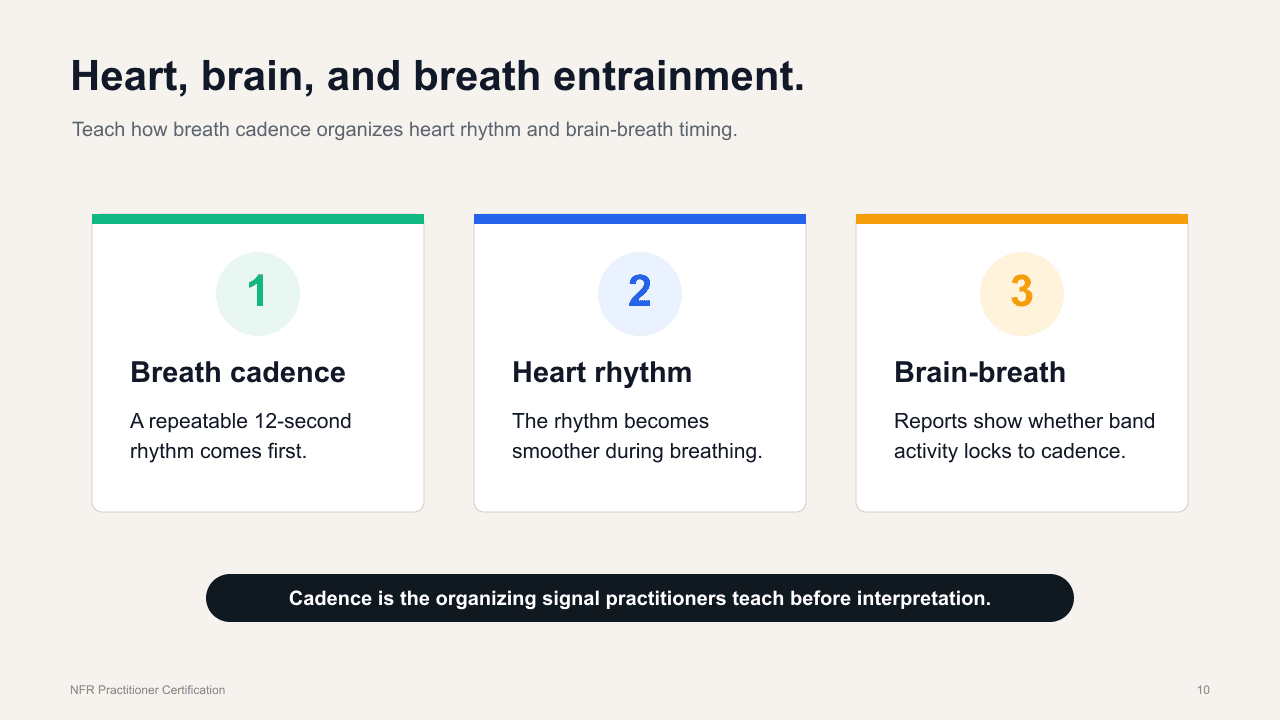
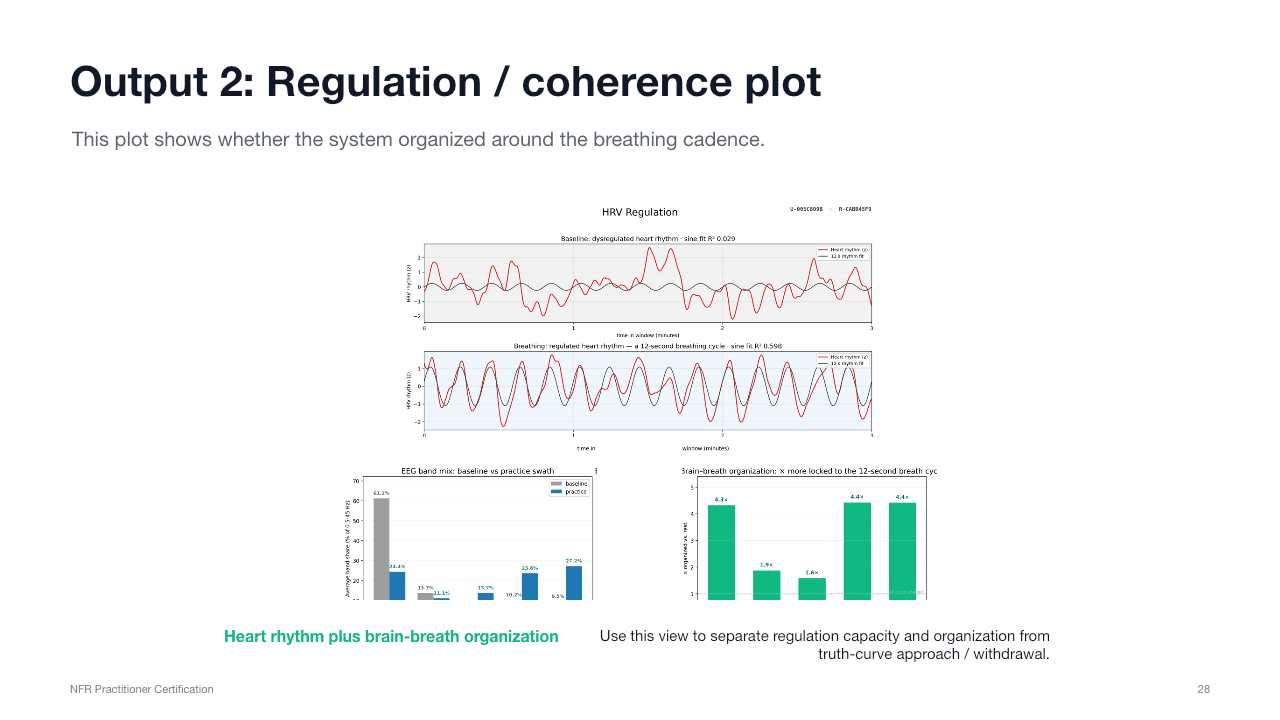
The breath is the conductor. The heart shows it as a smooth beat-to-beat HRV wave, and the EEG shows it as brainwave envelopes becoming more ordered around the same twelve-second cycle. NFR reads both channels: heart rhythm locking to the breath, and brain rhythms organizing around it.
The two states
Regulation and dysregulation
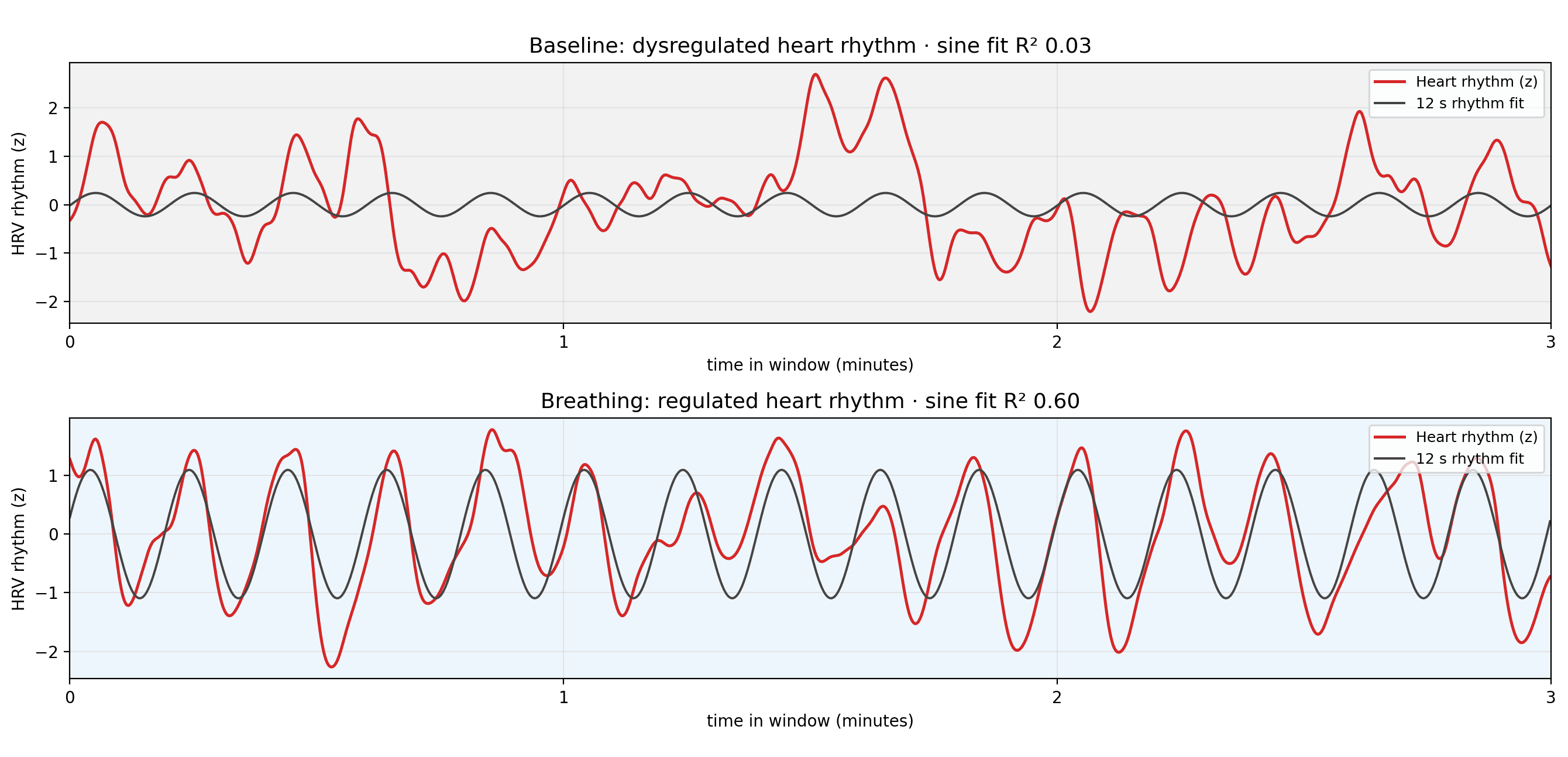
Dysregulation is the nervous system out of step with itself. Under stress the sympathetic branch dominates and the body’s rhythms run independently: the heartbeat’s timing erratic, the breath quick and shallow, the brain’s rhythms scattered. Nothing is synchronized, and each system keeps its own clock. It is the ordinary state of a braced, over-stimulated body, and it is largely what people are recording when they first sit down.
Regulation is the opposite: the parasympathetic brake engaged and those same systems settling onto a common rhythm. Coherence is the measurable signature of regulation: the breath pacing the system, the heart’s beat-to-beat rhythm following it, and the brain’s electrical rhythms becoming more ordered around the same cycle. It is not relaxation in the vague sense but a specific, readable physiology, and it is the state the breathing exists to produce.
The heart channel
HRV ordered by the breath
A healthy heart never beats like a metronome. The gap between one beat and the next is always changing, quickening a little on the inhale and easing on the exhale. That constant beat-to-beat variation is heart-rate variability, or HRV, and it is the clearest external readout of the vagal brakeThe calming hold the vagus nerve keeps on the heart — it slows the heartbeat, like a brake. The stronger that brake, the more the heart's timing flexes from beat to beat, which is exactly what HRV measures.. In a dysregulated state the variation is still there, but it is noise: erratic, with no pattern.
Coherence is what happens to that variation when the breath takes it in hand. Paced at the twelve-second cycle, the beat-to-beat rhythm stops wandering and begins to rise and fall as one smooth wave, locked to the breath. It is the same HRV, now ordered. That is the heart channel of coherence: variability pulled out of scatter into a single clean oscillation. It is why the heart strip is so useful, but it is not the whole NFR definition.
Illustrative. At baseline, breath, heart, and brainwaves run on their own; during coherence breathing they fall onto one shared rhythm — the brainwave envelope swelling on each breath.
Illustrative: breath, heart rhythm, and brainwave envelope, scattered at baseline, then locked into one coherent rhythm during practice.
The full pattern
What the diagram is showing
The diagram is the core NFR principle in one picture. At baseline, breath, heart rhythm, and brainwave envelope are all moving, but they are not moving together. Each signal has its own timing, so the nervous system is active without being organized.
During coherence breathing, the breath becomes the pacing rhythm. The heart follows it as a smooth HRV wave, and the brainwave envelope begins swelling in time with the same twelve-second cycle. That is the important shift: the brain is not merely getting louder or quieter. Its rhythms are becoming more ordered around the breath.
The brain channel
Brainwaves ordering to the same cycle
This is why NFR looks beyond heart rhythm. The EEG read asks whether each brainwave band becomes more phase-locked to the breathing cycle during practice. Delta, theta, alpha, beta, and gamma can all be measured as envelopes: slow rises and falls in the strength of that band over time. When those envelopes start rising and falling with the breath, the brain is organizing around the same rhythm the heart is following.
That makes coherence an ordering measure, not just a power measure. The meaningful question is not simply whether alpha or beta went up. It is whether the brain’s rhythms became more synchronized to the paced breath. In NFR, heart-breath lock and brain-breath ordering are two views of the same regulated state.
How it reaches the brain
A steadier heart, a steadier signal
Why should ordering the heart’s rhythm change anything upstairs in the brain? Because the heart talks to the brain far more than the brain talks to the heart. The main line between them is the vagus nerve, and most of its fibers, the vagal afferentsNerve fibers that carry signals inward, from the body up to the brain. About four out of five vagus-nerve fibers are afferent (inbound), which is why the brain mostly listens to the body., run upward, body to brain. The brain is mostly listening.
And it is listening to the heartbeat in particular. With every beat, the baroreceptorsPressure sensors in the walls of your arteries — the body's built-in blood-pressure gauges. They fire a burst of signals up to the brain with each heartbeat, timed to the pulse. fire a pulse of information up that line. When the heartbeat is erratic, what arrives in the brain is a jittery, noisy stream. When the breath pulls the heartbeat into one big smooth wave, the stream arriving upstairs becomes just as ordered. The timing of those pulses then measurably changes how excitable the cortex is, and how hard the brain’s alarm center, the amygdalaAn almond-shaped structure deep in the brain that drives threat detection and the fear response — the trigger behind 'fight or flight.', fires when something startles you.
The breath reaches the brain by a second route at the same time: its rhythm paces the brain’s own electrical waves directly. That is why, in NFR’s recordings, the brain’s slow rhythms begin to rise and fall with the breath during a paced segment. The heart sends a steadier signal upward, and the breath gives the brain a rhythm to organize around from within. Coherence is both routes converging.
What it trains
Not calm — state command
Here is the part that surprises people. In everyday life you actually want a heart rhythm that varies a lot. A heart that can speed up, slow down, and adjust on the fly is the mark of a healthy, adaptable nervous system. So why train it into one steady wave? Because the steady wave isn’t the goal. It is the exercise.
Coherence breathing doesn’t flatten your heart rhythm into stillness. It does the opposite. It drives the rise and fall bigger than normal, but smooth and even, all of it moving as one clean wave. You are deliberately pushing your system into a strong, ordered swing and holding it there for a few minutes. Done again and again, that rehearsal is what builds your everyday adaptability back up: a heart that recovers faster and a nervous system with more range to draw on.
The brain is training with it. When the heart locks to the breath and the brainwave envelopes lock to that same timing, the whole system practices moving from scattered activity into ordered activity. The point is not to make the nervous system quiet. The point is to make it responsive: able to gather itself, shift state, and return to baseline with less drag.
So the skill being trained isn’t ‘stay calm.’ It is the ability to change states on purpose, to settle yourself when you choose to and to come back down quickly after life winds you up. Stress isn’t the enemy here; recovering from it is the muscle. A small dose of stress you can bounce back from, practiced deliberately, is exactly what makes you harder to knock off balance. That is what the breathing curve is really measuring: not whether you are relaxed, but whether you can take the wheel of your own nervous system.
NFR’s own measured data
In one session the heart rhythm locked to the 12-second breath, with the coherence estimate rising from 0.11 to 0.56. The EEG showed the other half of the same state: brainwave envelopes becoming more ordered around that breath cycle. Across the cohort, the heart-breath sine-fit lock reached R² 0.71.
A study, up close
Training into coherence lowers stress and anxiety
Any single study can be a fluke, the product of a lucky room or a charismatic researcher. The hard test of an idea is what survives when you gather every decent trial and look at them all together.
Researchers did that with heart-rate-variability biofeedback, the practice of training people to breathe their heart rhythm into coherence, the very state NFR builds. They pooled the controlled trials, the ones with a real comparison group, and ran the numbers across all of them at once. The effect held. Across the combined evidence, learning to breathe into coherence reliably reduced stress and anxiety: not in one standout study but as a repeatable result that survives being averaged across many.
That is the state NFR's breathing produces and its instrument reads. The difference is that NFR doesn't ask you to take the shift on faith or rate it on a questionnaire afterward. It shows you the coherence climbing, live, in your own heart rhythm, while it happens.
Source: HRV-biofeedback for stress and anxiety — meta-analysis, Psychological Medicine. Source
A study, up close
The protocol behind every coherence trainer
Before anyone could ask whether coherence training worked as a therapy, someone had to pin down what, exactly, was being trained. In the late 1990s Paul Lehrer and his colleagues noticed something specific about the heart’s rhythms. When a person breathes at about six breaths a minute, heart-rate oscillations don’t merely rise; they hit a maximum, and heart and breath lock together. Whatever drove that peak had to be mechanical rather than psychological, because it appeared at one precise frequency no matter what the person was thinking or feeling.
The mechanism they identified was the baroreflex, the body’s continuous blood-pressure feedback loop. At about a tenth of a hertz, which is six breaths a minute, the breathing rhythm falls right on the baroreflex’s own oscillation. Breathing into it does more than relax the body. It exercises the baroreflex the way a load exercises a muscle, repeatedly working it at its resonant frequency, so the reflex grows more sensitive, more responsive, and better at steering blood pressure and heart rate. Cardiac variability climbs. And the team didn’t stop at the finding. They published a training manual: how to locate a person’s individual resonant frequency, how to pace the breath, and how to read the variability rising in real time.
That 2000 paper is the protocol ancestor of every HRV-biofeedback device and coherence-training platform built since. NFR runs the same mechanism. The twelve-second breath cycle is a resonance input, and the coherence score climbing on the screen is the baroreflex responding. When later meta-analyses pooled the trials and found stress and anxiety reliably falling, they were measuring the downstream effect of this exercise. Lehrer’s paper is where the design rationale was first written down.
Source: Lehrer, Vaschillo & Vaschillo (2000), Applied Psychophysiology and Biofeedback. Source
What the published research reports
“Slow paced breathing near resonance frequency creates temporal coherence across respiration, blood pressure, and cardiac oscillations, supporting strong HRV coherence around 0.1 Hz.”
Source: Review of slow paced breathing and HRV, Neuroscience & Biobehavioral Reviews. Source
“Cardiac vagal tone represents the contribution of the parasympathetic nervous system to cardiac regulation, linked to self regulation at the cognitive, emotional, social, and health levels.”
Source: Laborde, Mosley & Thayer (2017), Frontiers in Psychology. Source
“HeartMath coherence interventions improve psychological outcomes.”
Source: Systematic review of HeartMath interventions, Integral Review. Source
“The pre to post effect size within groups was 0.81. The between groups analysis comparing biofeedback to a control condition yielded Hedges' g = 0.83.”
Source: HRV biofeedback for stress and anxiety, meta analysis, Psychological Medicine. Source
“Biofeedback training to increase the amplitude of respiratory sinus arrhythmia (RSA) maximally increases the amplitude of heart rate oscillations only at approximately 0.1 Hz.”
Source: Lehrer, Vaschillo & Vaschillo (2000), Applied Psychophysiology and Biofeedback. Source
“What is the real longevity solution? Consciousness as the regulator of your biology.”
Cited findings are reported by their authors and linked to the source; named quotes are the speakers’ own views, attributed to the cited talk. NFR is an education and nervous-system measurement program; it is not a medical treatment or diagnosis. NFR’s own figures come from its recordings (single sessions and our growing cohort).